
Five Concerns We’re Carrying Right Now But Rarely Discuss
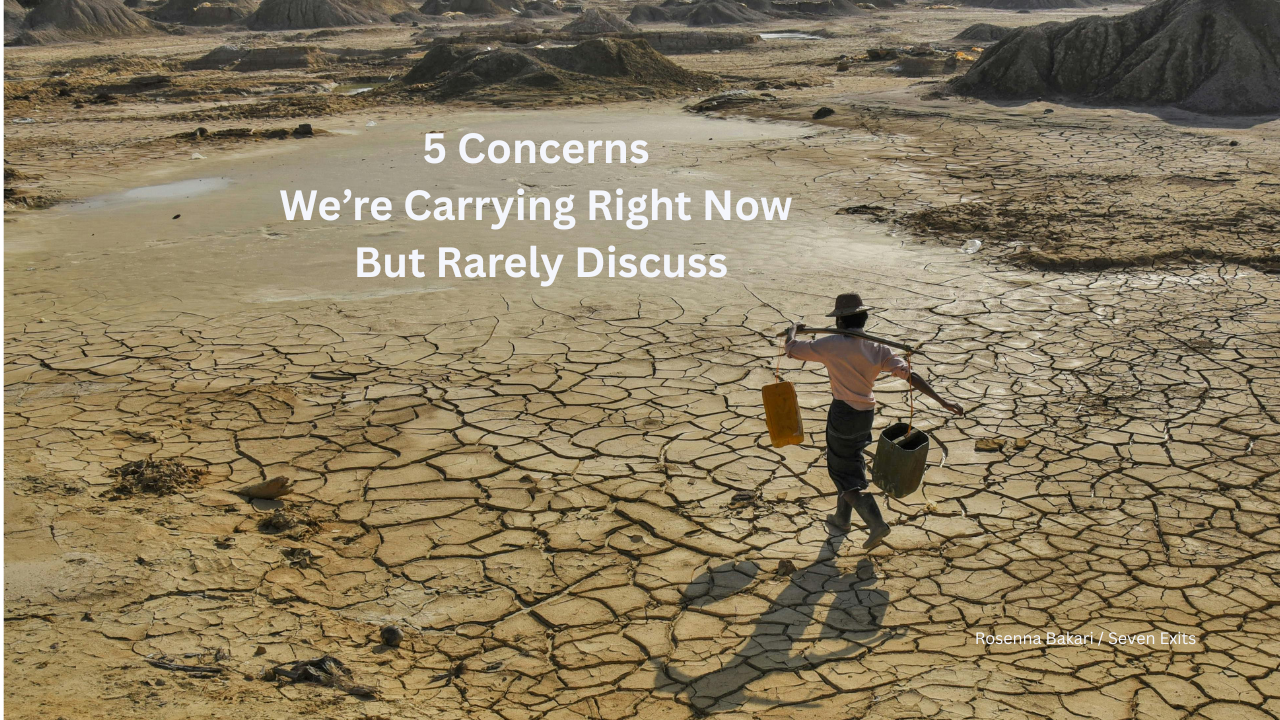
By Dr. Rosenna Bakari
Do you remember how quiet your household became when your parents were worried? There was a stillness in the air. It was a concentration you could sense but not fully understand. Asking questions felt risky. If you did ask whether everything was alright, the answer was usually reassuring. “Everything is fine.” And you returned to playing with your siblings or friends.
Well, lately, I’ve been feeling a bit like Phil Collins; I can feel something coming in the air. There’s an atmosphere I can’t quite ignore. A focused sort of haze.
People are going about their work, caring for their families, meeting responsibilities, and planning their futures. Yet there is also a sense of vulnerability that isn't spoken, but is showing up in the silence. I sense a collective fear that the slightest misstep could be catastrophic. For so many people, life requires heavy concentration right now.
In conversations, certain concerns surface briefly. Someone launches a complaint here or a critical observation there. Then the discussion quickly shifts and everyone returns to their daily routines. The personal concerns remain present, but hidden in people’s psyche.
Top Five
Right now, five concerns seem to be sitting heavily on people’s minds as we all wait to exhale.
1. The future of the country
Many people are questioning what kind of country their children will inherit.
For decades, Americans built their lives around a set of assumptions. Institutions would function. Systems would provide a measure of stability. And if you worked, saved, and planned responsibly, you would have a strong foundation to support your family.
That foundation is now being examined more closely than ever before. Questioning the future brings many people face-to-face with their sense of inner authority: Do I have what it takes to navigate whatever comes next? Can I protect and provide for the people who depend on me?
2. Job security
Many people go to work each day aware that their position could disappear tomorrow.
Few people assume that a job will last indefinitely. In response, many are building their own forms of insurance. Some develop side businesses or professional skills that give them options if their position suddenly disappears. Others are scaling back their lifestyle.
Employees may continue performing well, contributing ideas, and supporting team goals. But their contingency plans remain as private as their unspoken anxiety about it.
3. Retirement
Many people, whether approaching retirement or early in their retirement planning, are reconsidering whether they can build a nest egg large enough to maintain their quality of life.
People have long questioned what support government programs might provide and whether those benefits will keep pace with inflation. Right now, that concern feels elevated.
As a result, older people are recalculating their timelines. Younger people are opting for more lucrative degrees. There is no more "out of sight, out of mind" approach. Retirement is an increasing concern at decreasing ages.
Money has always been treated as a private topic. Conversations about savings, investments, and debt tend to remain behind closed doors. The heightened concern, however, is widely shared.
4. Raising children
Many parents are concerned about their children’s resilience.
Over the past decade, child diagnoses related to anxiety, depression, and behavioral disorders have risen steadily. Schools are reporting more incidents of violence among young people. Teachers and employers alike are expressing concern that many young people struggle with basic critical thinking and problem-solving skills.
Parents see or hear these trends. Many want to believe their own children will be exceptions. It is comforting to assume that the statistics apply to someone else’s household. But beneath that hope is a deeper awareness that their children may be showing signs of emotional vulnerability already.
5. Mental health
Many people are working hard to appear emotionally steady while managing far more internal pressure than others realize.
The pace and uncertainty of modern life place increasing demands on emotional regulation. That includes the ability to focus, negotiate, communicate effectively, and soothe oneself when stress rises.
Under these conditions, people attempting to manage their psychological well-being often do so privately. The standard rule still applies: you must look OK, even when you are not OK. The weight people carry is rarely discussed directly.
We’re In It Together
None of this invisible weight stops people from living their lives.
Yet all of it can be felt collectively. Just as research has shown that children often carry the psychological burdens of their parents, societies can transmit a shared emotional atmosphere that shapes how people think, work, and relate to one another.
People absorb the emotional climate through what they see happening around them every day. Here's some of the evidence.
- Social tolerance shifts, and people think more carefully about what they say, where they say it, and how it might be received.
- Children are stepping into adult roles earlier, not in ways that strengthen them, but in ways that short-circuit their childhood.
- Some of the roles most essential to developing a society, like teaching, are increasingly difficult to fill.
- The tone of public conversation has sharpened, especially across social media, where disagreement leads to conflict instead of curiosity.
Slowly and unconsciously, we collectively speak with more caution, take fewer risks, and undermine our own authority by acquiescing to "what's coming in the air tonight."
How Businesses Should Respond
The invisible labor people carry into their leadership can make the work feel much heavier. But, when leaders consider the human experience, they and those they lead are more likely to succeed.
Organizations are not separate from the emotional climate of the society around them. The weight people carry does not disappear when they arrive at their desks. Employees bring their psychological energy to the workplace.
Invisible loads manifest as mental fatigue, quiet quitting, resistance to feedback, and tension between colleagues. Leaders often interpret these signs as problems of engagement, productivity, or retention. In reality, they are often signals of strain rather than simple performance issues.
Many of the pressures influencing work behavior originate outside the organization itself and can feel taboo to discuss at work. For leaders, this raises an important question. If people are working to maintain their own sense of stability and inner authority in a rapidly shifting environment, what kind of leadership strengthens that effort rather than undermines it?
Leadership in this moment requires more than strategy and performance management. It requires an understanding of the psychological environment people are navigating every day.